When More People Can Build Software, What Becomes Harder to Replace?
As more people can build useful software, what becomes harder to replace? A reflection on the experience, judgment and shared understanding that turn a working application into something a business can depend on.
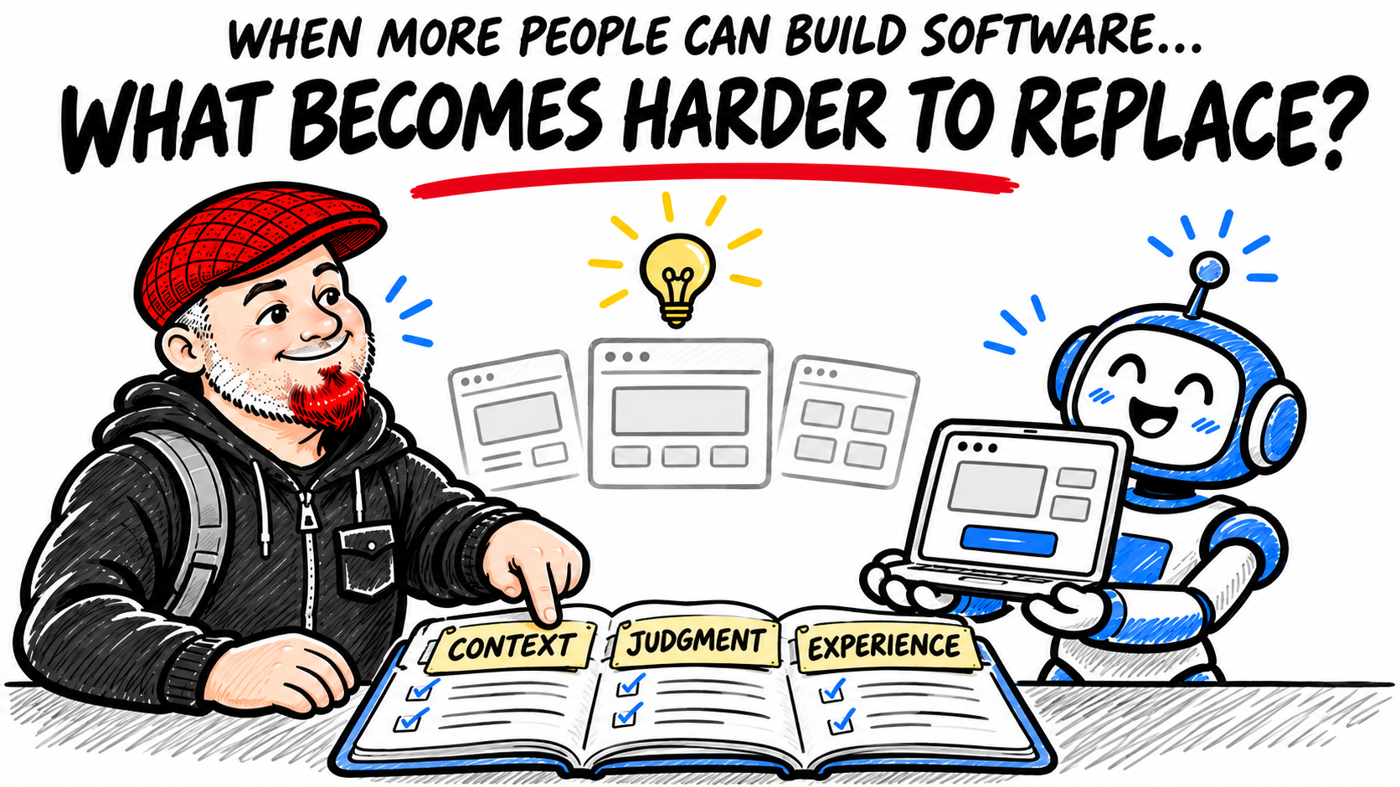
When more people can build software, what becomes harder to replace?
I've been turning that question over in my head.
With tools like ChatGPT, Claude and Gemini, more people can turn an idea into a small working application. A tracker. A calculator. A tool that takes care of the annoying part of their day.
Honestly, I think that's pretty great.
The person doing the work can build something around how the work actually happens. Something that fits what they need, when they need it.
But if more people can create the application, where does the value sit?
Knowing what needs to happen
I keep coming back to the person who understands the process.
The person who knows why a step exists. Who remembers the exception that never made it into the documentation. Who can look at an answer that seems perfectly reasonable and say, “That won't work here.”
Imagine a parts tool that finds the right item on a shelf. Useful. But what if that item is already reserved for a customer? Or a replacement needs someone to confirm compatibility before it ships?
The application has to account for those things. Somebody has to know they matter, make that knowledge available and check that the tool handles them correctly.
I think that understanding becomes more valuable as building gets easier.
The spreadsheet problem, with buttons
There's another side to this.
Imagine three departments building tools for the same process. Each one solves a real problem. Each one defines “complete” a little differently.
Now the business has three useful applications and three different answers.
That feels familiar. A spreadsheet starts as a workaround. Other people begin relying on it. Eventually, nobody wants to touch a cell because nobody remembers what it does.
Now give it buttons and a nicer interface.
I can see us creating a lot of useful software this way. I can also see us creating a lot of complexity that nobody intended.
Some friction is information
We talk a lot about removing friction. I want less unnecessary waiting as much as anybody.
But sometimes the friction is telling us something. Two teams disagree about the process. Nobody owns the decision. The information isn't reliable enough to act on.
Building around the problem can make one person's day easier while leaving the underlying disagreement unresolved.
So the guardrails matter. Who owns the tool? Which information should it trust? Who checks the output? What happens when the process changes?
A personal experiment and an application that changes customer records need different levels of review.
And the knowledge needs to be shared. If the whole process depends on one person remembering one exception, we've created another problem.
What becomes harder to replace?
I started this thought wondering whether software was losing its value as intellectual property.
I'm still working through that. But the question I find more useful is what makes a tool worth relying on when building something similar becomes easier.
We're all seeing some of the same tools, marketing and problems. More people are going to have similar ideas.
Maybe the harder thing to replace is the judgment behind the work. Understanding which problem is worth solving. Bringing the right people into the conversation. Knowing what a good result looks like and taking responsibility for checking it.
That judgment can improve with better tools, too. It still needs to show up somewhere in the process.
I want people to be able to build what they need. I also want the business to understand what it's beginning to depend on.
When more people can build software, what becomes harder to replace?
My answer, at least right now, is the understanding behind it.
What's yours?