Your Bot Is Your Brand
AI can make customer service better. Start with the experience you want customers to have, then decide whether you have the tools, people, and budget to deliver it.
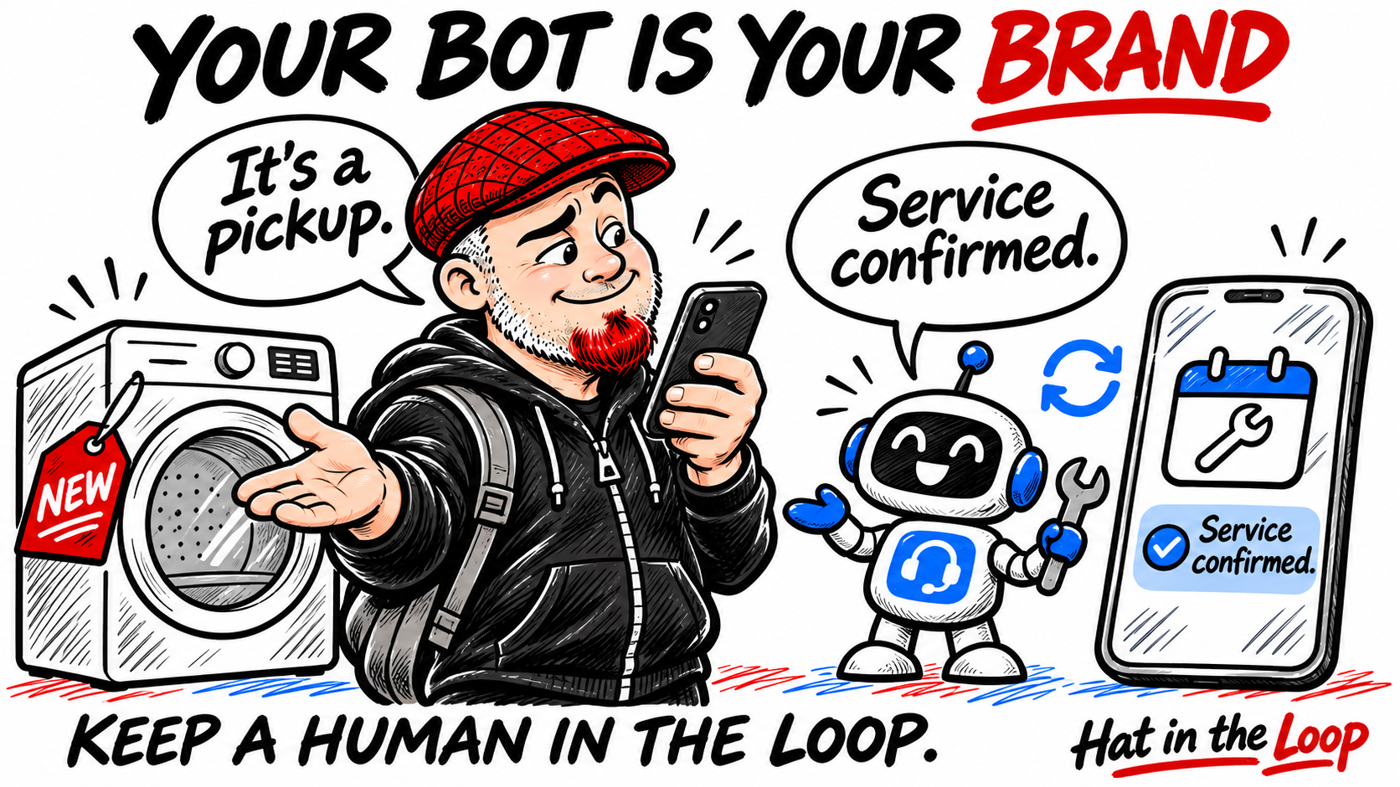
I paid more for a dryer because I trusted the company selling it.
I've bought from them before. Great buying experience. Great service. The kind of place where I'm willing to spend a little extra because I expect them to take care of me.
Then the brand-new dryer arrived with a broken sensor.
They initially wanted to repair it. I wanted a replacement. We talked it through and agreed they would pick it up and arrange a swap.
Okay. Things happen. We had a plan.
Then the texts started.
Somebody would be coming out to service the dryer.
I replied that this was supposed to be a pickup.
Another service confirmation.
I explained it again. If this wasn't a pickup, please have somebody call me. Could I get a number to call?
No callback. No useful answer. Just another confirmation that somebody would be there to service the dryer.
At first, I thought I was texting with a person. An AI link in the exchange led me to believe it was automated. I can't verify exactly what was running behind it, but I know what the experience felt like.
Nobody was listening.
Monday morning, I finally reached a person. We talked. The confusion was resolved.
But by then, part of my weekend had been spent wondering whether I wanted to buy from this company again.
I work in AI. I love these tools. And I think there are companies doing a great job using them in customer service.
AI can help customers get answers faster and give employees the information they need to solve a problem. There are plenty of good reasons to use it.
But I think too many businesses are jumping ahead with one question in mind: How much can we reduce our costs?
I don't know what drove this particular company's decisions. But cost reduction alone is a poor starting point for designing a customer experience.
The first question should always be: How do we make this better for our customers?
How do we get them to what they need faster? How do we make it easier to correct a mistake? How do we keep them from having to explain the same problem over and over?
If AI helps you do that, awesome. Use it.
If it doesn't, or you don't have the capabilities, staffing, or budget to make the whole process work, you're not ready to put it in front of your customers.
That budget has to cover more than the bot. It has to cover getting it the right information, checking whether it's actually helping, and making sure somebody can step in when it gets stuck.
Saving money can be a result of better service. It can't be your only definition of success.
If the customer says the appointment is wrong, your system needs a way to check it. If they ask for a person, that request needs to reach a person. If nobody is available until Monday, say that and explain what happens next.
The customer already spent the money. Something went wrong. They're disappointed. Empathy matters here. So does the ability to act on what they're saying.
A person on the phone made the difference for me. They could hear the problem, understand why I was frustrated, and resolve the confusion.
That's what I mean by a human in the loop. Someone has to be able to step into the conversation and do something.
I see this as a company issue. The company chooses the process, the tools, the staffing, and what happens when something goes wrong. The company is responsible for those decisions.
And those decisions can be better.
Start with the experience you want your customers to have. Give your people and your technology what they need to deliver it. Then check whether the customer actually got the help they needed.
I was willing to pay more because of the experience. A weekend of messages had me reconsidering that loyalty.
Your bot is part of your brand. You still own the experience.
Where could AI make it easier for your customers to get what they need... and where does a person need to step in?