Wait... My AI Vendor Is Going to Sell What?
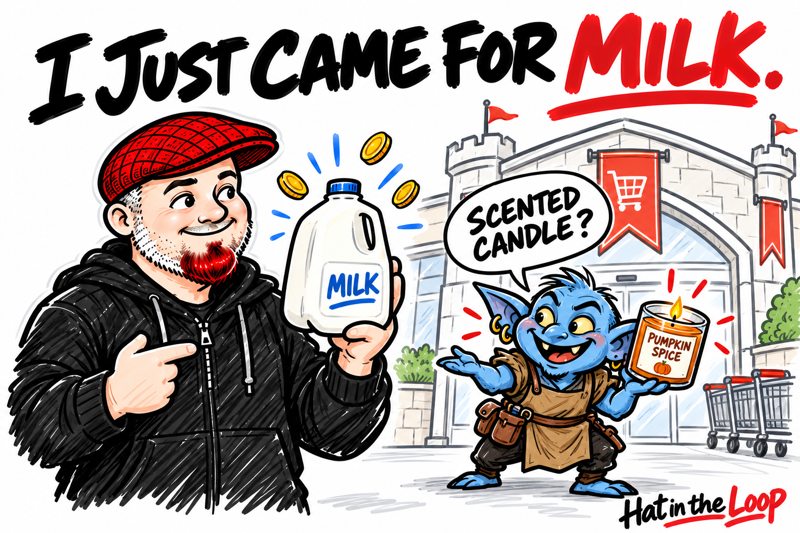
My brain went from Anthropic's IPO to light bulbs. Stay with me. What happens when the company selling you intelligence decides it wants to own a business in your industry?
Anthropic filed to go public this week. [1]
Naturally, my brain went straight to light bulbs.
Stay with me.
I've been thinking less about the stock ticker and more about what kind of company it could become. What happens when the company selling everyone intelligence decides it would also like to own some of the businesses using it?
I don't think "AI company" is going to describe the whole business a few years from now.
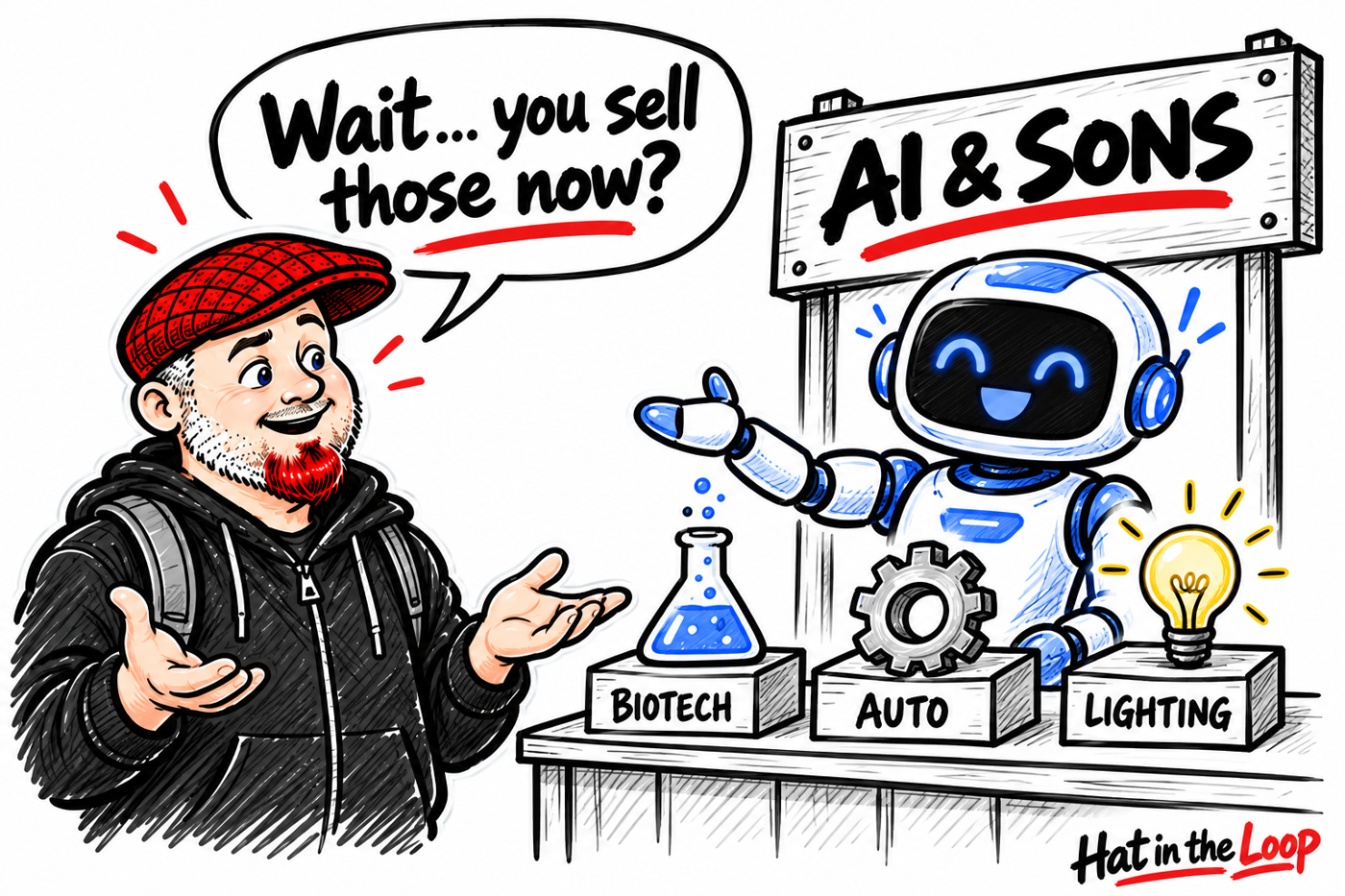
My prediction is that some of these companies will build portfolios of businesses with AI at the center. Different industries. Different products. Different teams. A shared intelligence platform helping all of them do the work.
A biotech business. An engineering business. Automotive components. Maybe light bulbs. I don't know. I am not predicting a Claude lighting aisle at Home Depot.
I'm talking about the structure. Different businesses, built around the same intelligence, each owning something people actually pay for.
Some of those businesses could eventually compete with the companies buying their AI today.
Well... that should make the next vendor renewal meeting interesting.
Now, before I give them a light bulb division, let's separate what has happened from where my brain is taking this.
On October 27, Anthropic disclosed its acquisition of Mithril Medicine, a small biotech developing treatments for rare muscular dystrophies. It now has internal drug-development programs. The work remains early and preclinical. This is evidence of entering discovery, not proof of a successful medicine. [2]
OpenAI's October 20 acquisition of Orchestra Bio points to a related opportunity: software that coordinates drug development. Owning that platform is different from owning a pharmaceutical pipeline. Both moves bring the AI provider closer to the work its customers perform. [3]
Anthropic's S-1 also describes expansion into healthcare, life sciences, robotics, and physical work, alongside possible acquisitions and partnerships. It does not announce a conglomerate with automotive and manufacturing divisions. That part is my forecast. [4]
This is the part I keep coming back to.
If your technology helps everybody else build a better business, at what point do you ask, "Should we own one of those?"
When a company sells access to a model, it gets paid for the service. The customer uses that intelligence to build something, solve a problem, or make money.
If the provider can help create a valuable product, it has more choices. It can charge a software fee. It can negotiate a share of the outcome. It can license an invention. It can invest in the business. Or it can own the business itself.
Those choices capture very different kinds of value.
Selling somebody the tool is one business. Owning a piece of what they build with it is another. I can see why an investor might be interested in that second conversation.
They also bring very different costs. Owning the product means taking responsibility for its development, failures, customers, and consequences. A larger share of the upside comes with a larger share of the work.
For me, the interesting part is the architecture underneath it. This is where I stop thinking about a chatbot and start thinking about how the work gets done.
Imagine a common platform for research, coding, planning, coordination, and checking results. Each business adds its own specialists, industry data, equipment, customer relationships, and operating rules.
The biology team still needs biologists. The engineering team still needs engineers. Somebody still has to test the thing, manufacture it, support it, and take responsibility when something goes wrong.
You can't put "act as a pharmaceutical company" into a prompt and call the whole thing handled.
But those teams may be able to operate differently because they share a capable intelligence platform. Research, planning, coding, coordination. Capabilities they can reuse across businesses instead of building everything from scratch every time.
That is where the data conversation gets more interesting to me.
There is value in organizing existing information. There may be considerably more value in using it to decide what experiment to run, testing the result, and creating knowledge that did not exist before.
A model suggesting a better material is a starting point. A validated material with a useful property, a repeatable manufacturing process, and customers willing to buy it is a business opportunity.
The company that controls that whole process may own something much harder to copy than a chatbot interface.
That's the part of the data conversation I want to spend more time on. What did you learn? What did you prove? And what can you actually do with it?
This does not require a factory for everything. A business could own a design or a research program and work with specialist partners to develop, manufacture, or distribute it.
We already have a useful example in Isomorphic Labs. Its announced Lilly and Novartis collaborations combine upfront payments and milestones with potential royalties. That is a way to participate in drug-development economics without becoming the manufacturer of every medicine. [5]
And then we get to the awkward part.
If I build my business around somebody else's intelligence, could that supplier eventually offer the same service I sell?
"Thanks for being a valued customer. Also, we're doing what you do now."
To be clear, that's my imaginary renewal email. But the business question behind it is real.
That risk can exist without anyone misusing customer data. Anthropic and OpenAI both say they do not train on business inputs and outputs by default. Competitive expansion and customer-data use are separate questions. [6][7]
A provider can still build a competing product using its own research, public information, licensed resources, acquisitions, and industry specialists.
So the business question gets bigger than which model has the best benchmark this month. It includes who owns the customer relationship, who controls the workflow, what information the customer can move, and how easily the model can be replaced.
Now I have to argue with myself a little.
My first thought was that this might be the only way these companies deliver the returns their investors expect. The more I work through it, the less comfortable I am with "only."
I can't say becoming a conglomerate is the only way these companies produce a return for investors. A broadly used intelligence platform could become a substantial business. So could enterprise software, royalties, or partnerships. Buying companies and entering difficult industries can also destroy value.
Owning more businesses also gives you more ways to have a very expensive Tuesday.
My stronger prediction is that the winners will be selective.
They will keep selling intelligence where being the supplier is attractive. They will pursue ownership where their technology creates an advantage worth the extra cost, risk, and customer friction.
Biotech is already showing us an early version. A full automotive business is a much bigger leap. A company using AI to improve vehicle engineering, diagnostics, or service is easier to imagine arriving first.
And owning the model doesn't mean you automatically beat everybody using it. An established company may know its customers better, have stronger distribution, or simply be better at delivering the actual product. Amazing software is still software. Somebody has to run the business.
I am watching for businesses that own intellectual property, products, and customer revenue. Those would tell us much more than another industry-specific chatbot.
The question I keep coming back to is this:
Is the company helping you build your business also getting ready to build one of its own... in your industry?
I don't think that's a reason to stop using the tools. I do think it's a reason to pay attention to who's selling them.
Sources checked October 29, 2026:
- Anthropic's proposed IPO announcement, October 26.
- Anthropic's drug-development update, October 27.
- OpenAI acquires Orchestra Bio, October 20.
- Anthropic S-1, filed October 26.
- Isomorphic Labs' Lilly and Novartis collaborations, January 7, 2024.
- Anthropic commercial-data training policy.
- OpenAI enterprise privacy commitments.
Originally posted on anthropic.com. Join the conversation there.