The Part Nobody Called In
A seal kit on the shelf before anyone calls. A practical look at agentic AI beneath the work, and what we'll build together at AEM Annual in Tucson.
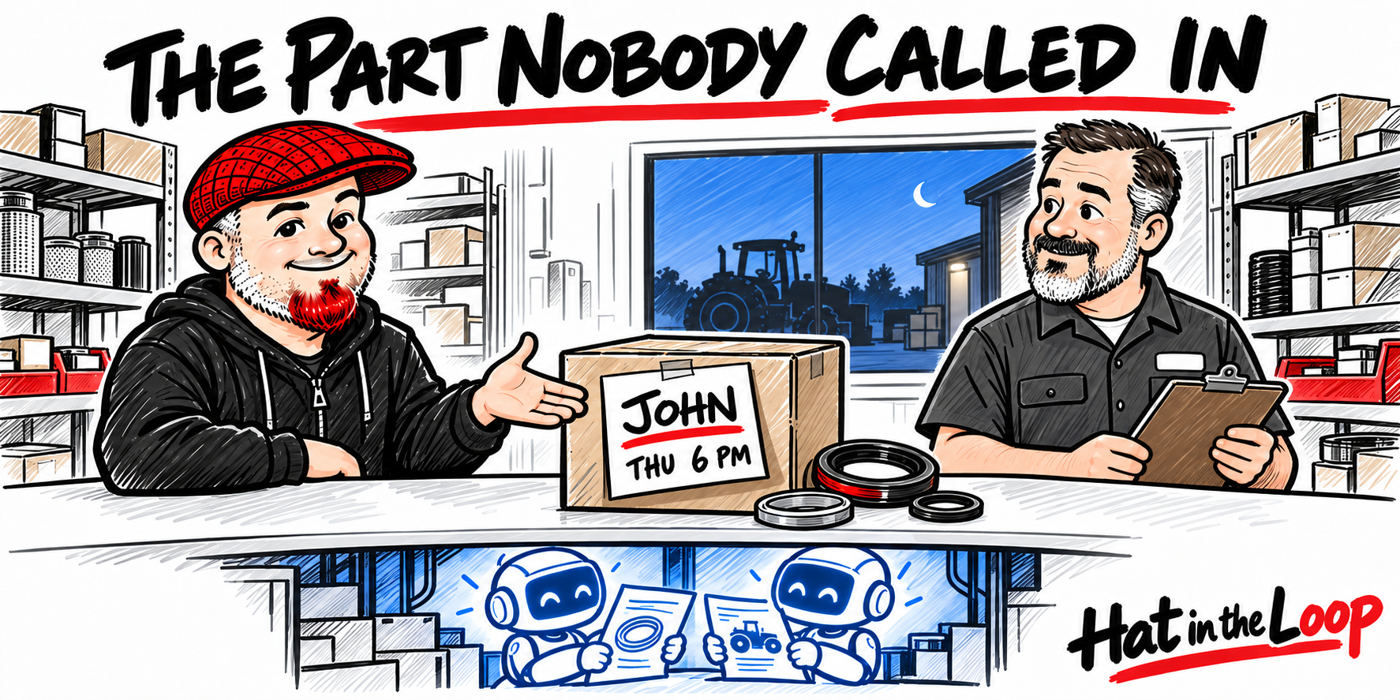
Picture a dealer parts room at night, a few weeks before harvest. One seal kit sits on the shelf. The tag on the box has a customer's name on it, and a service time.
Here's the part I love... nobody called it in.
No panicked phone call. No rush order. No tractor sitting dead in a field with a hydraulic leak.
This is an illustrative scenario we'll work through in Tucson. Three days earlier, that customer's tractor was out working and quietly sending data home, like it always does. Hydraulic pressure had been drifting below its normal range. An agent pulled together the machine's operating history and a maintenance alert pointing to possible seal wear. Enough warning to recommend an inspection before harvest.
A second agent did what a good parts counter person does. It found the right kit and checked it against that serial number. Then it noticed two things. There was only one kit on the shelf, and three more tractors in the same territory were showing a similar pattern.
The service manager, let's call him Dave, reviewed the evidence and the proposed plan. He approved setting the kit aside and contacting the customer.
So the farmer, let's call him John, got a text from his own dealer. Here's what we're seeing, we've set the part aside, pick a time for an inspection before harvest. He picked Thursday at six.
Dave got a 60-day planning view instead of a fire drill. He kept the one kit for John, approved an order for three more, and offered the other owners an inspection slot before harvest. On Thursday, the tech inspected John's tractor, confirmed the wear and made the repair.
The seal was on its way out. John got to choose when the tractor came off the job.
John, Dave and the tech in the bay made the service and inventory decisions in that story. And not one of them logged into anything new.
Why AI pilots stall out in the field
If you build or sell equipment, you can roll out a new tool inside your own organization. Engineering, product safety, warranty, parts... you have some say in how all of that works.
Across the road it's a different world. Dealers are independent businesses carrying four, five, six lines. Field techs work for the dealer, not for you. Every request you send across that line competes with everything else they have to do.
That's where AI pilots go to die.
MIT Project NANDA's preliminary 2025 GenAI Divide report said roughly 95% of organizations in its research had no measurable profit-and-loss impact from their GenAI efforts. The authors pointed to weak workflow integration and a lack of contextual learning. It was a preliminary snapshot, with varying samples and definitions of success. The useful lesson is the fit with the work.
I see the same problem in our industry. The demo was fine. The pilot stalled anyway, usually for one of three reasons:
- It added work. Someone had to copy data in, check the answer and paste it back. In a dealership that's two techs short, that someone doesn't exist.
- It added a place. One more window, one more login, one more habit. The network already has too many of all three.
- It added doubt. One confident wrong answer in front of a 25-year tech, and that tool is done for good.
The network rarely says no to a new portal or app. It just doesn't log in. And honestly, that dealer who still calls instead of using your portal isn't the problem. That dealer is telling you something.
Put the agents beneath the work, not on top of it
Most AI rollouts I've seen in heavy equipment were built on top of the work. A better chatbot. A smarter portal. Something the dealer has to go to.
The idea I keep coming back to is the opposite... put the agents beneath the work people already do, so the work shows up done, or nearly done, in the places they already look.
My test for whether something is really beneath is simple:
- Nobody in the network gets a new login.
- It reaches people in their channel, not yours. Email, text, the dealer management system, a phone call.
- The agent does the prep. A person makes the call.
- Every action leaves a trail you could hand to an auditor.
Where do you start? With the work nobody sees. Nobody gets promoted for it, and it falls apart the day the person who does it retires.
Across a dealer network, it tends to come in three flavors:
- Follow-ups. Who hasn't finished the safety campaign, signed the bulletin or renewed the cert? Chase them politely, with exactly what they need.
- Cross-referencing. Check the claim against the serial, the build record, the bulletin and the part number before it bounces back to the dealer as a rejection.
- Signal aggregation. Pull the same problem out of claims, tech notes, parts orders and call logs, even when everyone describes it in different words.
That takes work behind the scenes: reliable records, clear permissions and someone who owns the exceptions.
The goal is for dealers and techs to keep working in familiar channels. They get a clearer email, a faster answer, or a part that's already on the shelf.
What we'll work through in Tucson
I'm running a 90-minute interactive workshop at AEM Annual called Guiding the Unseen: Agentic AI Across Unprepared Networks.
You'll be talking at your table, sketching on paper, and arguing with the person next to you about objections.
We open with the parts story, then get practical:
- A four-phase deployment model. Observe, Assist, Act, Extend, with clear gates between each one. In the first two phases, you prove value inside your own walls before asking the network to change how it works.
- A 90-day pilot. One boring, measurable task, a handful of friendly dealers, and a real decision at day 90: scale it, adjust it, or stop it. Stop has to be a real option.
- A 12-month roadmap. How one task becomes a crew of agents, each with one job, one owner and a trail.
- The objections you'll hear, and how to answer them. "Our dealers won't adopt another tool." "Our data is a mess." "This is a product safety risk." "What's the ROI?" We'll drill them in pairs.
You'll walk out with your own pilot sketched on a one-page canvas: the task, the owner, the pilot dealers, the baseline and the sentence that defines success at day 90.
You don't need a new software budget to start mapping it the following week.
Come find me at AEM Annual
The 2026 AEM Annual Conference runs November 10 to 12 at the JW Marriott Tucson Starr Pass Resort & Spa in Tucson, Arizona. This year's theme is "Moment to Rise: Limitless Possibilities."
My workshop is in the 8:30 to 10:00 AM slot. Bring coffee. Bring a pen.
Before you come, try this. Think of one thing your company chases dealers or field teams for, by hand, every single week. Campaign completions. Warranty claim fixes. Inspection forms. Bulletin sign-offs.
Write it down. That's the task we'll build your pilot around.
And if you can't make it to Tucson, tell me in the comments what you chase your network for. I read every one.
Sources