The Claude Before Claude
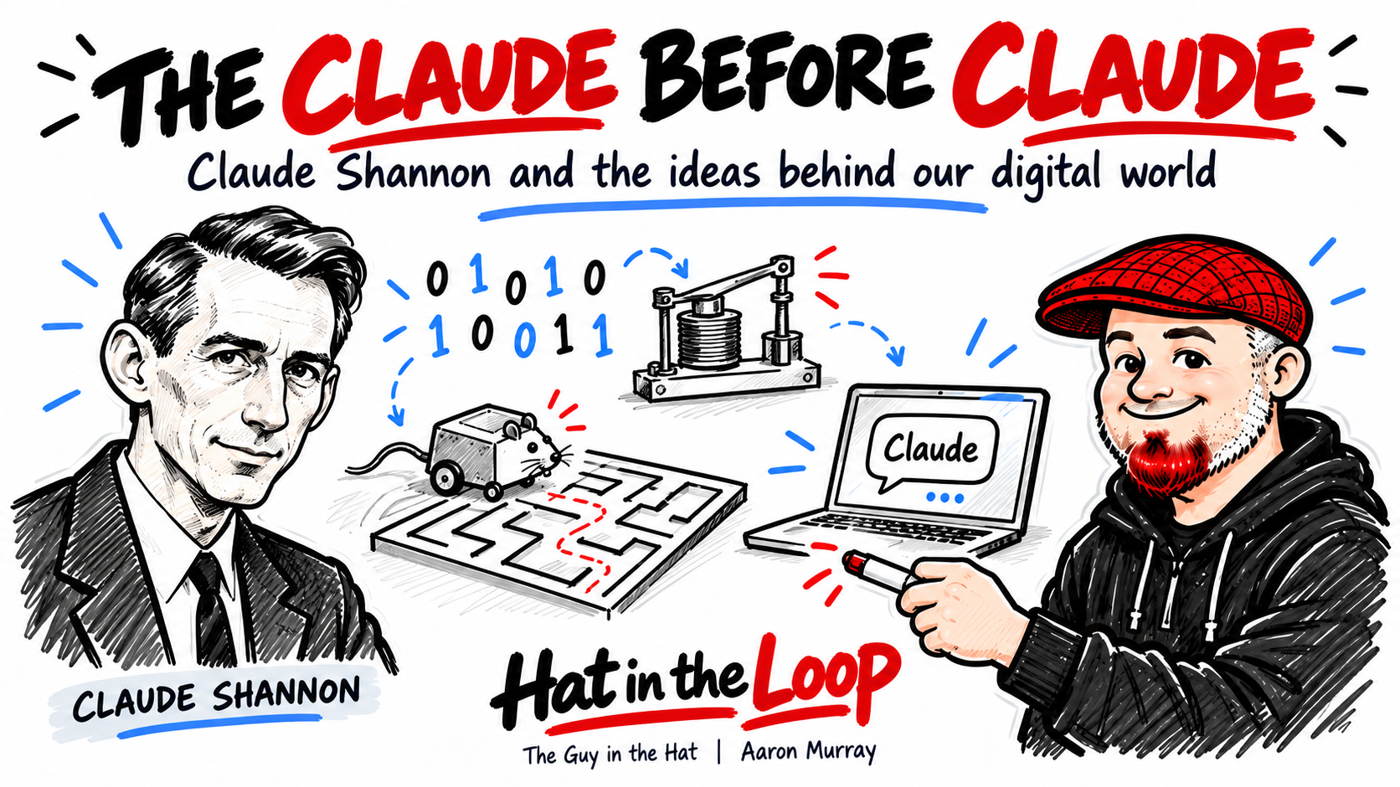
Claude Shannon helped establish the foundations of our digital world. His work on circuits, information and language explains the connection to Anthropic’s AI assistant.
We spend a lot of time talking about what Claude can do. Write code. Work through a document. Help us make sense of something complicated.
But there is a pretty good story behind that name.
Claude Shannon was a mathematician and electrical engineer whose work helped establish the foundations of digital computing and modern communication. The phone in your pocket, the files you send and the digital systems running your business all owe something to the ideas he helped develop. MIT’s account of his life gives a sense of just how much ground he covered.
And yes, there is a documented connection to Anthropic’s Claude.
In an interview published in 2024, Anthropic researcher Deep Ganguli connected the assistant’s name to Shannon and his early experiments with generating language. He described it as “a very nerdy in-joke.”
I appreciate a good nerdy in-joke. This one comes with a lot of history.
Shannon’s first enormous contribution grew out of his MIT master’s thesis. He showed how Boolean algebra, the mathematics of logical relationships such as AND, OR and NOT, could be used to analyze and design electrical switching circuits.
Think about that for a second. You could take a logical rule and build a physical arrangement of switches that carried it out. That connection became a foundation of digital circuit design. His thesis helped give engineers a systematic way to do it.
Then came the work that earned him the title “father of information theory.”
In 1948, while working at Bell Labs, Shannon published A Mathematical Theory of Communication. He developed a mathematical framework for questions that still sit underneath our digital lives: how much information can a system carry, and what happens when noise gets in the way? Bell Labs still celebrates that work as a foundation of modern communications.
One central idea was that information could be measured in terms of uncertainty. Learning the outcome of a fair coin toss resolves one bit of uncertainty. Before the result, there are two equally likely possibilities. Afterward, you know which occurred.
Shannon also established limits on reliable communication. Under the conditions of his theory, suitable coding can make transmission errors arbitrarily unlikely when the information rate stays below a channel’s capacity. Noise does not automatically make reliable communication impossible. There are mathematical limits, and engineers can design toward them. MIT’s explanation of the Shannon limit makes that surprisingly approachable.
That is a big part of why he matters. He helped turn communication into something engineers could measure, reason about and improve.
But the part that brings us back to Claude is language.
In his 1948 paper, Shannon built examples that became progressively more like English. Start with random letters. Account for how frequently letters appear. Then account for which letters tend to follow others. Move on to words and the patterns between them.
As more of the language’s statistical structure entered the process, the results looked more like recognizable language.
He took that further in his 1951 paper on predicting English, using people’s guesses about the next letter in a passage to investigate how predictable language is. The text already available gives clues about what might come next.
You can see why people building language models would appreciate that history.
There were many later advances between those experiments and today’s AI. Shannon’s work belongs near the beginning of that story, and Ganguli’s explanation makes the naming connection especially fitting.
Also, this was a man who liked to build things.
Around 1950, Shannon created Theseus, an electromechanical mouse system that could find its way through a maze. The control circuitry lived beneath the maze. It was an early experiment in machine learning, made with hardware you could actually look at and work on. He also built juggling machines and enjoyed riding a unicycle. The MIT Museum’s collection captures that wonderfully curious side of him.
A person who could help establish an entire field and still spend time building a mechanical mouse is my kind of technology person.
There is one more piece of Shannon’s work I think matters when we talk about AI today.
His communication theory deliberately set aside a message’s meaning to focus on the engineering problem of transmitting it. Measuring information and delivering it reliably does not establish whether its contents are true.
For me, that distinction has a very practical application.
A system can deliver an outdated parts record perfectly. An AI assistant can produce a beautifully written answer from that record. The part number can still be wrong.
We still have to care about the source, the context and the person responsible for the decision. That is my takeaway for using these tools at work.
Claude Shannon deserves to be remembered for the foundations he helped build. The chatbot’s name gives us a useful reason to stop and notice them.
The next time you open Claude, spare a thought for the other Claude: a mathematician with a maze, a unicycle and some questions that helped change how the world communicates.