Own Your Data. Keep Your Options.
Before buying another SaaS or AI tool, ask how easily you can access, export, and reuse your data. Build a data foundation your business controls, so your next tool remains your choice.
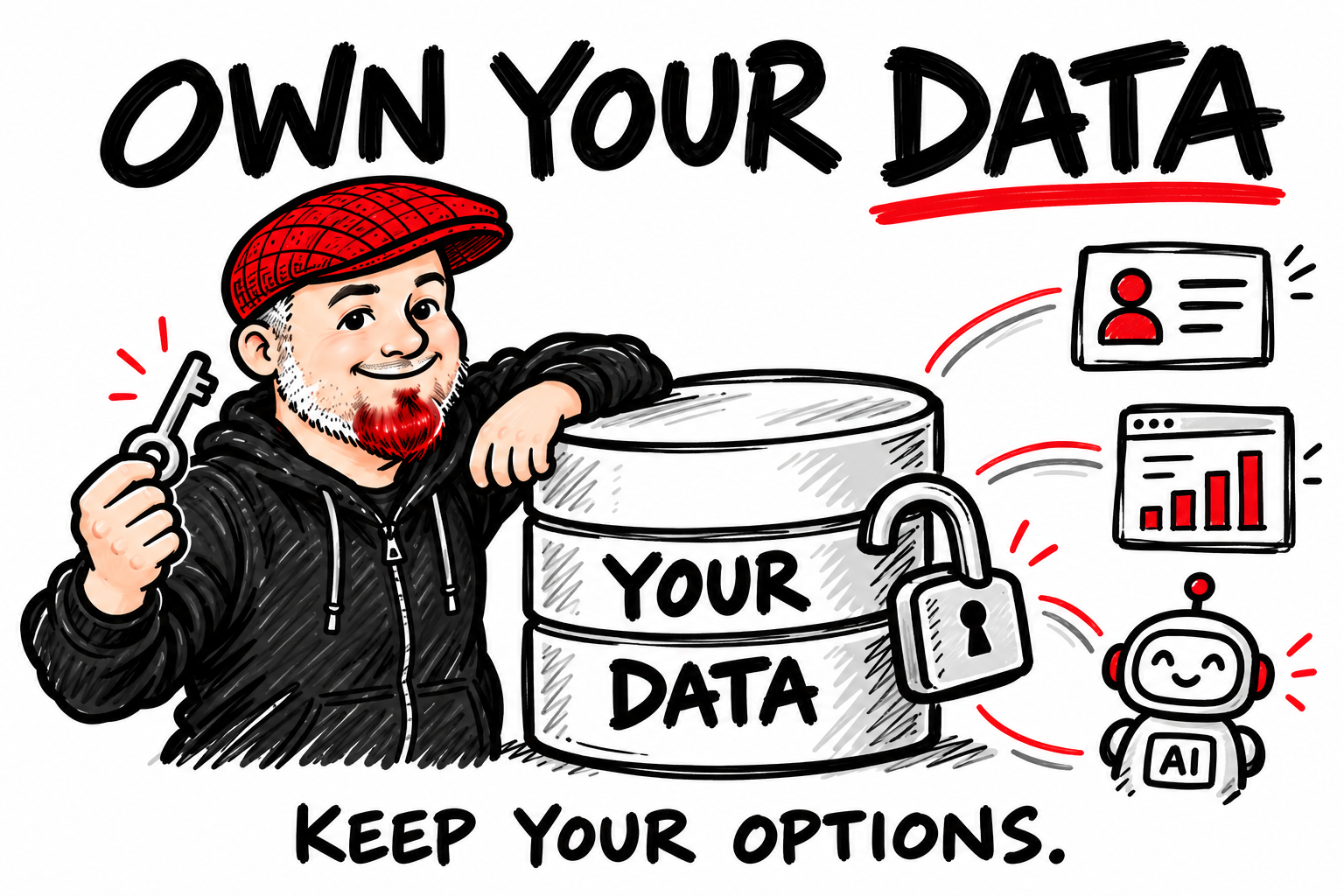
Stop letting your software decide what you can do with your data.
We put customer information into CRMs. Campaign results into marketing platforms. Service history, product information, and operational knowledge into a dozen other tools.
Then we want to bring it together and actually use it.
That is where the fun starts.
Can we export it? Does the export include everything we need? Is API access included? Do we need another subscription, another connector, or another dashboard just to make sense of information our own team entered?
If accessing that information becomes a project of its own, something is wrong.
I have no problem paying for useful software. But I want to know what it will take to use our data beyond that software.
The next time you sit through a SaaS demo, ask this before you get distracted by the dashboard:
“Where is our data, and how easily can we use it somewhere else?”
Then get specific:
- Can we export the records, attachments, history, and relationships we need in a usable format?
- Can our other tools access it through a documented API? What are the limits and costs?
- Can we keep an up-to-date copy in an environment we control?
- What happens to our access, and how do we retrieve our data, if we leave?
Ask them to demonstrate it. A sample export and a working connection tell you more than a slide that says “integrates with everything.”
This matters even more when we start talking about agentic AI.
An AI co-worker handling a customer request may need information from sales, service, and operations. If each system holds a different piece of the story, we need a reliable way to bring the relevant pieces together, with the right permissions and a clear source.
Buying another AI tool does not make that work disappear.
That is why I keep coming back to building a data foundation your business controls.
Depending on the work, that could be a database, a warehouse for structured reporting, or a lake for varied data you need to retain and process. Those solve different problems. You do not have to build all of them, and you do not have to start with a lake.
Start with one useful business problem. Identify the data it needs. Make that data accessible. Clean it up. Define what the fields mean. Decide which record is authoritative. Assign someone to keep it current.
You can use managed infrastructure and still make control and portability requirements. Owning the hardware is not the point.
Being able to access, understand, protect, and reuse your information is.
I believe businesses that do this work will be in a much better position to put AI to use. They will have more freedom to choose the tools that fit the job and change those tools when something better comes along.
I cannot preach this enough.
Own your data. Make it usable. Keep your options.