Muse Spark Open: Big AI. Your Hardware.
Meta has released a massive open-weight model optimized to run across two Mac Studios. The exciting part is what that could mean for running useful AI on hardware you control.
Okay. This is pretty insane.
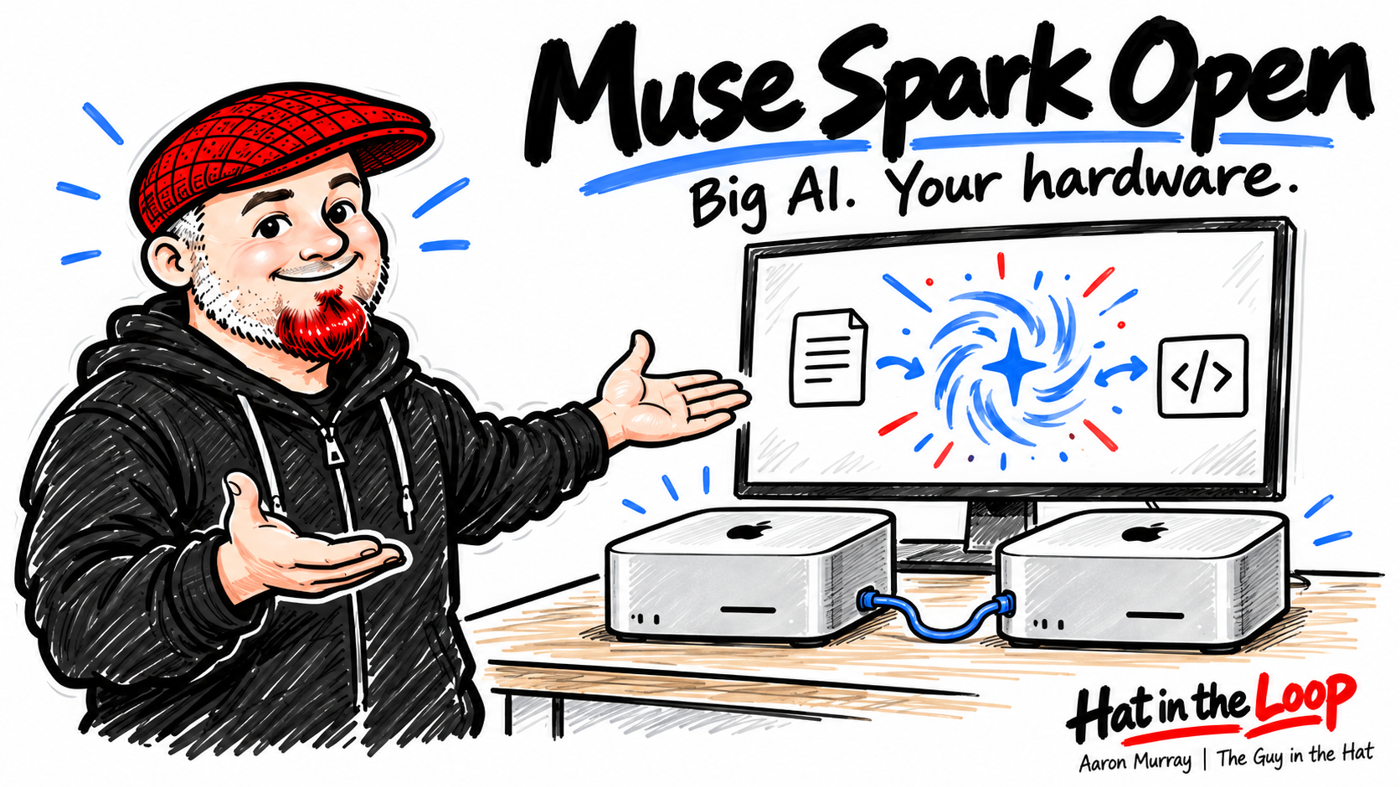
Meta just released Muse Spark Open, and the part that stopped me was a model this large running locally across two Apple Mac Studios.
Meta. Apple. A very big AI model sitting on a desk.
Yes, I have questions. I also really want to see where this goes.
Meta's announcement describes a model with 816 billion total parameters, 42 billion active per token, and a one-million-token context window. It is built for coding and agents that work through longer, multi-step tasks.
Those numbers are enormous. The part I care about is being able to download the model weights and run the model on hardware you control.
I keep coming back to this: where does your data go, who controls the system, and how much of your business depends on somebody else's platform?
A local model gives us another way to answer those questions.
Imagine an internal assistant working through your company's documents, or a coding agent helping with software you would prefer to keep inside your environment. Those are the kinds of workflows I would want to test. The work still has to be useful, accurate, and worth the cost.
My concerns about handing data to Meta have not magically disappeared. What interests me here is the ability to run downloaded weights in an environment I control. That changes what I would be evaluating.
It also means looking beyond the model. If an agent sends information to an external tool, hosted service, or logging system, local inference alone will not keep that information inside your walls. You still have to understand the whole workflow.
Now, about those two Macs.
The setup described by Meta uses two M5 Ultra Mac Studios with 512GB of unified memory each, running Apple's MLX framework. That is a terabyte of combined memory. Definitely a conversation with the person who approves the equipment budget.
Apple's technical write-up puts the model's 4-bit memory footprint at about 493GB, before the additional memory needed to run it. That is why this configuration spans multiple machines.
So I would treat this as serious infrastructure planning. Hardware, power, maintenance, and the people keeping it working all belong in the cost calculation.
There is another detail I would keep in view: open weights come with license terms. Meta is releasing this under the Muse Model License, with conditions on use and some commercial deployments. Downloadable does not mean unrestricted. The model card and license are part of the evaluation.
I have not tested Muse Spark Open myself yet. My excitement is about the direction this represents.
I want businesses to have more choices about where AI runs. I want a useful workflow to survive a model change. And I want us to spend more time asking whether the system actually helps somebody do their job.
That is how I would judge this release: give it a real task, measure the result, understand the cost, and see what stays under your control.
An AI model this large running across desktop hardware gives us something very interesting to investigate.
What would you build first if you could keep the model and the working data inside your own environment?
Aaron Murray | The Guy in the Hat
Originally posted on research.meta.ai. Join the conversation there.