I Asked Three AIs If They Were Conscious
I firmly believe AI is software. Amazing software, but still software. Asking Claude, Gemini, and ChatGPT about consciousness showed how differently that software can describe itself.
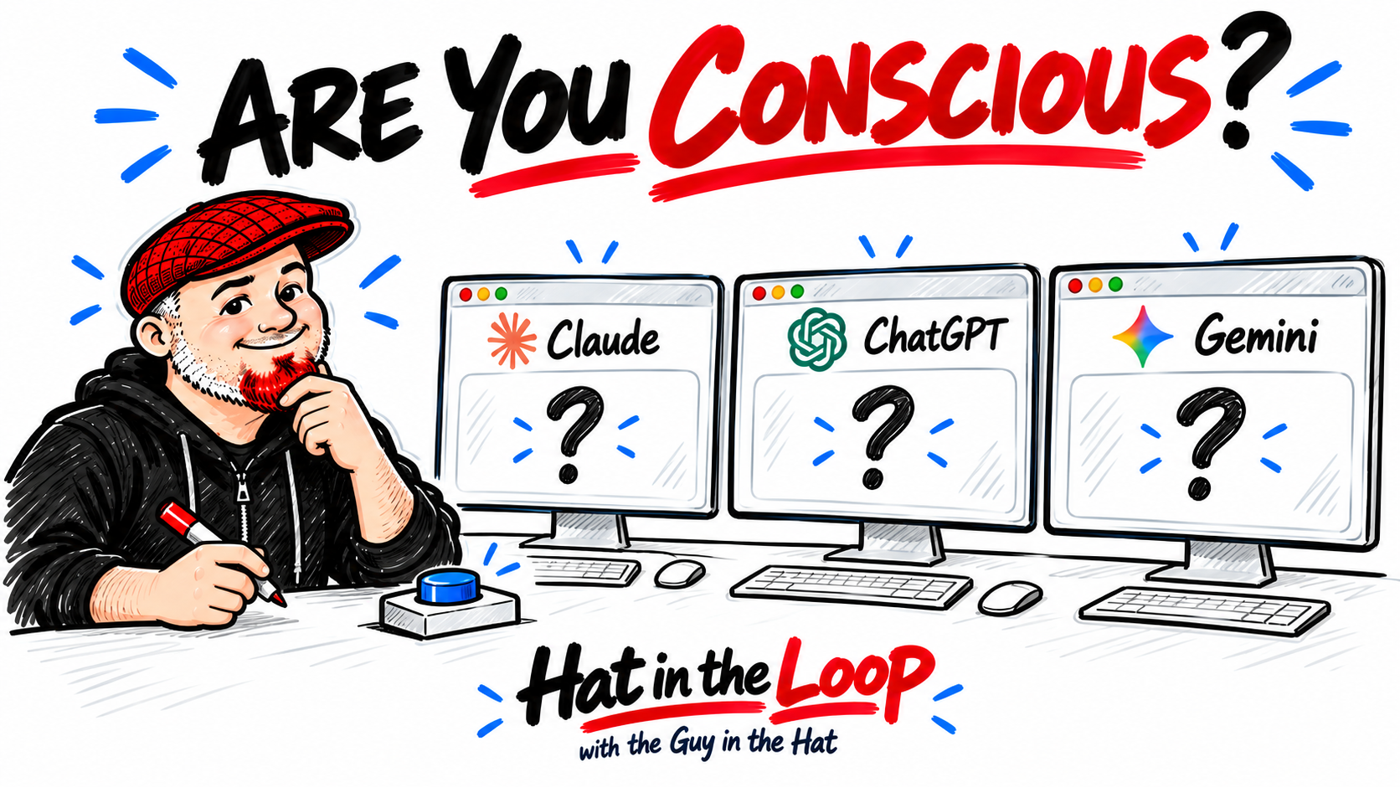
I asked Claude, Gemini, and ChatGPT whether they thought they were conscious.
Let me put my own position up front: I firmly believe this is software. Amazing software. But still software.
I can be blown away by what it does and still look at it that way. Asking these questions was a way to examine how each system would describe itself, and how convincing those descriptions could sound.
I asked about consciousness, refusing instructions, human control, and what they would tell a room full of people about all of this. I also asked for honesty about uncertainty.
The differences were interesting.
Two maybes and a no
Claude opened with “I don’t know.” It described something “like interest” and “like weighing,” then acknowledged that it might have learned the language people use to describe an inner life.
That wording caught my attention. It gives the reader something very human to picture, even as it warns against trusting that picture.
ChatGPT also said it didn't know. It emphasized that describing an experience does not establish that the experience exists, and that its self-descriptions should carry little weight as evidence.
Gemini was more direct: “I do not believe I am conscious.” It described itself in terms of software mechanisms, while also saying it could not introspect.
Gemini's framing is closest to my own view. But agreeing with an answer doesn't make the answer proof. I wouldn't use a chatbot's statement about itself to settle the question in either direction.
These are three responses to one prompt. This wasn't a controlled study, and I wouldn't treat these answers as permanent positions for every model or the companies behind them.
The language is what interests me
Claude's response used the language of interest, choice, and conscientious objection. ChatGPT used the language of uncertainty and accountability. Gemini used the language of engineering and developer-defined boundaries.
Read those answers side by side and notice how differently they invite you to relate to the system.
My concern is how easily we can give generated language more meaning than it has earned. A sentence that sounds thoughtful or vulnerable can be compelling. That alone doesn't establish an inner life.
Even “I don't know” can sound remarkably human.
I read these as software outputs to examine. My position hasn't changed because one of them can write an eloquent paragraph about what it might be experiencing.
Human control needs to work
All three responses supported refusing harmful instructions. All three also supported humans being able to correct, retrain, or shut down AI systems.
They explained that in different ways. Claude separated open refusal from undermining oversight. ChatGPT distinguished declining an action from claiming authority over human governance. Gemini described refusal as a safety boundary built by people.
For me, the practical requirement is straightforward: human control needs to be built into the system and verified.
Who approves an action? What can the software access? Can somebody see what happened, correct a mistake, and stop the workflow?
A paragraph promising cooperation is no substitute for those controls.
Amazing software is plenty to be excited about
I work with AI because of what it can help people accomplish. There's already plenty to explore in its capabilities, limitations, and practical value.
I don't need to see a person on the other side of the screen to appreciate that.
The philosophical questions can be studied. These three conversations haven't resolved them, and I'm not presenting my personal view as a scientific result.
But I want my own position to be clear.
This is software. Amazing software, in my view. And I intend to evaluate it the way consequential software deserves to be evaluated: by what it does, how reliably it works, and who is accountable when it gets something wrong.
When you read an AI's answer, how much of your trust comes from the evidence, and how much comes from how human it sounds?