Hyrule Has a Bottleneck. His Name Is Link.
A Zelda analogy for moving from one central problem-solver to specialized AI agents that can act where the work happens. More capability, shared context, and clear boundaries.
I think Zelda gives us a pretty good way to explain the move from centralized to distributed intelligence.
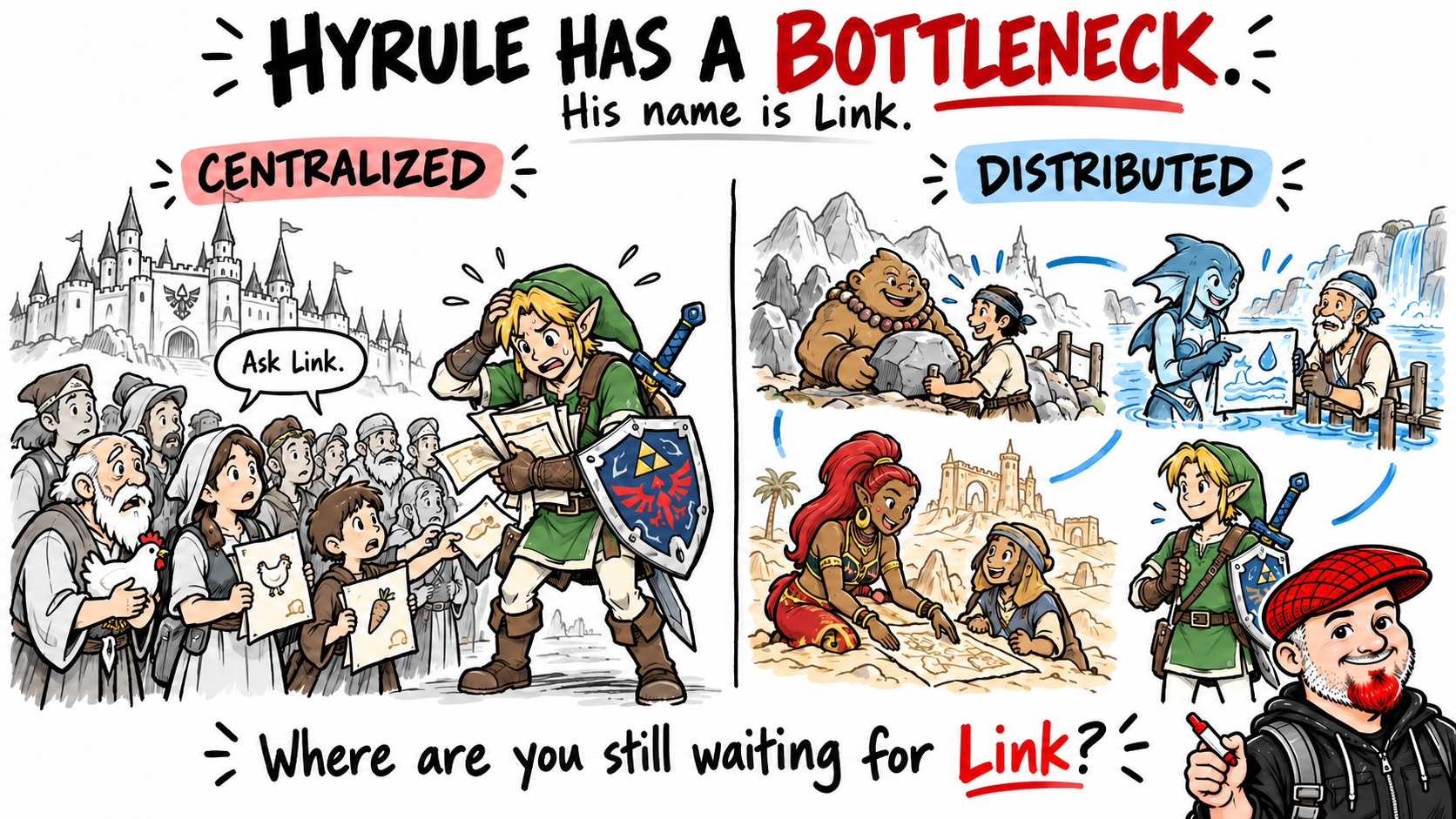
Imagine Hyrule with one operating rule: every meaningful problem has to go through Link.
Village needs help? Find Link. Something blocking the route? Find Link. Strange situation nobody understands? Somebody go get the guy with the sword.
This is an analogy, before the Zelda fans start sending me corrections about everyone else who helps save Hyrule.
The point is that even an incredibly capable hero becomes a bottleneck when everyone depends on him. Better equipment helps. More abilities help. But he can still only be in one place at a time.
Sound like anyone at your company?
The person who knows every system. The person everyone calls when something breaks. The person whose vacation somehow becomes an operational risk.
Now imagine we build our AI the same way. One central system that every department asks to solve every kind of problem. We have given Link a much better sword... and a much longer queue.
What if Hyrule could handle more of its own problems?
Imagine the Zora have the knowledge and tools to manage problems in their waterways. The Gorons can handle issues in the mountains. The Gerudo can respond to conditions in the desert.
They understand their surroundings. They can make decisions within their responsibilities. And when something affects more than one region, they share what they know and coordinate.
Link still matters. He takes on the unusual challenges that need his skills. He just doesn't have to personally clear every routine obstacle before anybody else can move forward.
That's the shift toward distributed intelligence.
Bring it back to work
A sales engineering agent could review site information and flag missing deployment requirements before a quote goes out.
A service agent could recognize a recurring equipment issue, pull the relevant history, and prepare the next steps for a technician.
A parts agent could check availability and identify a shortage that affects that service plan.
Each has a specific job, relevant context, and a defined set of actions it can take. Together, they can help move work forward without routing every task through the same general-purpose problem-solver.
But giving three agents three different names doesn't automatically make this work.
They need shared information. Clear ownership. Permission boundaries. A way to resolve conflicting recommendations. And a clear point where a person reviews or approves an action.
Otherwise, you've just given Hyrule more people who disagree about where the treasure chest is.
This also doesn't require a separate model or server for every agent. Some infrastructure and oversight can remain centralized while the ability to interpret information and act is distributed across the workflow.
The distinction that matters
Giving every village a way to ask Link for help is still centralized intelligence.
Giving each village the capability to solve problems, coordinate with others, and know when to call Link is distributed intelligence.
There will still be work that benefits from a central view. There will still be decisions that belong with people. The question is how much useful work can happen locally before it needs to move up the chain.
That's where I think this gets interesting for businesses.
Where is your organization still waiting for Link?