The AirPods Analogy: Why Messy Data Makes AI Slow, Expensive and Wrong
The short version of my messy-room analogy from AEM Annual: why messy data makes AI Co-Workers slow, expensive and wrong, and what a clean room and a clear ask change.
- Format
- Presentation
- When
- Nov 11, 2026
- Where
- Tucson, AZ
The AirPods Analogy
Open full screenClick into the slides, then use the arrow keys (or swipe) to move through them.
This is the short version of an analogy I used at AEM Annual. It gets more nods than any architecture diagram I've ever shown.
It starts in my bedroom.
Meet my bedroom
I'm a guy who explodes in my room. Clothes everywhere. Nothing folded. Baskets of laundry waiting their turn. I also have three kids, so that's just what's going to happen.
Your data probably looks a lot like this. Not because anyone did it wrong. Because work happened.
The errand
"Hey, I left my AirPods in my room. Can you go grab them for me?"
That's the whole prompt. To me it's obvious. To my kid, it's the entire room.
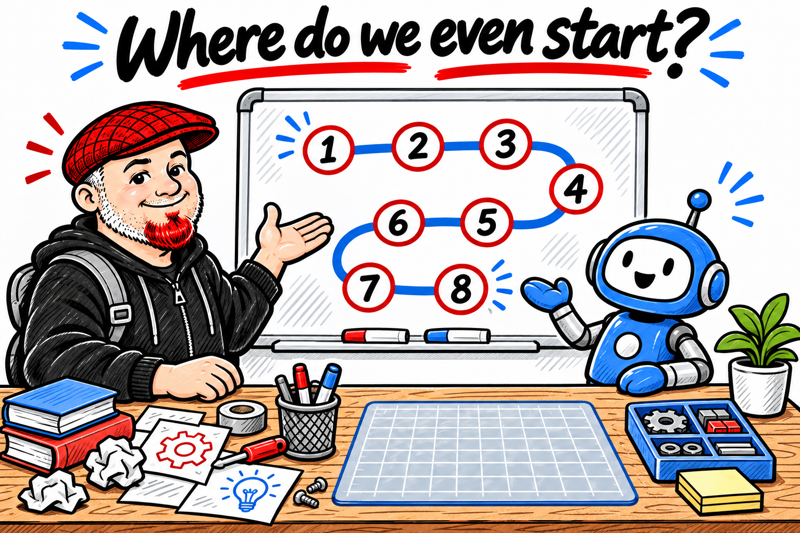
Jacket pocket. The desk. Dresser drawers. The nightstand. The pile on the bed. The laundry basket. The jeans on the floor. Under the bed. Eight places, and I'm being generous.
Every one of those is a place an AI Co-Worker has to go look when the data isn't organized.
Three ways this goes
- It takes forever. They check every pocket, every drawer, every pile, and eventually they find them. The AI version: every place it looks costs tokens, time and energy.
- They come back empty. "Couldn't find them, Dad." The AI version: "I don't have enough information to answer that."
- They bring the wrong thing. "Found these!" An old pair of wired headphones. The AI version: a confident answer built on the wrong data.
Number three is the dangerous one. Nobody gets hurt by "I couldn't find it." People get hurt by the wrong headphones handed over with a smile.
My kid wasn't being lazy. My kid did the best job they could with what I gave them. So will the AI.
Clean the room. Then ask better.
Two fixes, in this order.
First, the room. Organize it, so there's a place for everything. Cleanse it, and toss what's broken or old. Label it, so the drawers say what's inside.
Then, the ask. "My AirPods are in the white case, charging on the nightstand on my side of the bed. Can you bring me the case?"
"Got 'em."
Same kid. Same AirPods. Thirty seconds instead of ten minutes and some yelling. And they come back with the right thing.
The order matters. A great prompt into a messy room still means searching. A clean room with a vague ask still means guessing. You want both.
The lake and the warehouse
Here's where the bedroom turns into your data.
A data lake is every piece of clothing dumped into laundry baskets. Everything, raw, in one place. Cheap to store, slow to search.
A data warehouse is folded, sorted and in labeled drawers. Duplicates merged, blanks fixed, one name for each customer and each part. Fast to ask questions of.
You need both. The lake makes sure nothing is lost. The warehouse makes sure you can find it. Together they're one place to look and one version of the truth.
The room is the stack
- Clothes everywhere... your data spread across the ERP, CRM, files, email and spreadsheets.
- Everything in laundry baskets... the data lake.
- Labeled dresser drawers... the data warehouse.
- My kid... an AI Co-Worker. Smart, willing, and only as good as the room and the ask.
- "Bring me the case on the nightstand"... the prompt and the objective. What to get, where it is, and what done looks like.
Why it pays
Organized data pays you back four ways. Cost, because less searching means fewer tokens. Energy, because every extra lap through the room burns compute. Speed, because one place to look beats a scavenger hunt. And trust, because there's much less chance of the wrong headphones. That last one is why people keep using an AI Co-Worker after week two.
If you remember one thing
The AI will do the best job it can with what you give it. Give it a clean room.
Slides
The short deck is below. Click into it and use the arrow keys to walk through it yourself.
So... what does your room look like right now?