AI Level Set: Plain-English AI Before We Go Further
A quick, plain-English pause in the middle of my AEM Annual workshop: what generative AI, LLMs and agents actually are, rent versus own, why tokens matter, and what to do when your people are already using AI.
- Format
- Presentation
- When
- Nov 11, 2026
- Where
- Tucson, AZ
AI Level Set
Open full screenClick into the slides, then use the arrow keys (or swipe) to move through them.
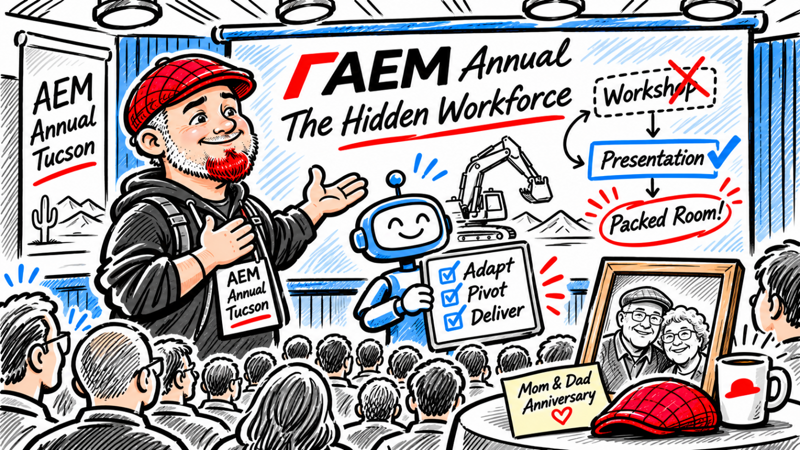
Partway through my Guiding the Unseen workshop at AEM Annual, I stopped.
Not because I lost my place. Because I wanted to know who I was talking to before I went any further. Some rooms are deep into AI. Some are still figuring out what the words mean. Most are both at once.
So we did a level set. Here's what's in it, and you're welcome to borrow it for your own team.
Where's the room?
Hands up if you could explain what generative AI actually does. Keep it up if you could explain what makes an agent different from a chatbot. Keep it up for what an open-weight model is.
Then: which one do you use at work? Copilot, ChatGPT, Claude, Gemini, something you built, or "not allowed yet."
And my favorite follow-up... did you pick it, or was it handed to you?
How are you actually using it?
This is where the room does the talking. What did you use it for this week? Where did it save you real time? Where did it get it wrong, or where aren't you allowed to use it?
You'll hear drafting emails, summarizing meetings, Excel formulas, a first pass at a manual. You'll also hear "legal said no" and "it doesn't know our parts."
Here's the thing I want everyone to notice. Almost everything on that list is something you went to, asked, and pasted back. That's AI on top of the work. Hold on to that. It's the gap the rest of the workshop is about.
Four words people use like they mean the same thing
They don't. They fit inside each other.
- Artificial intelligence: software that does things we used to think needed a person. Your spam filter counts.
- Generative AI: makes new things... text, images, code.
- Large language model: predicts the next word, extremely well. On its own it can't look anything up or take an action. That's why it sounds confident even when it's wrong.
- Agent: an LLM with a job, tools and permissions, working step by step until the job is done or a person needs to decide.
A chatbot answers. An agent works.
Give an agent a job, like finding the tractors that need a seal kit before harvest. It plans the steps, uses real systems to act, checks the result against the rules, and hands off to a person when a decision is needed.
With a chatbot, you ask, it answers, and you do the work. With an agent, you give it a job, it does the steps, and you approve.
Rent it or own it
Closed models (Claude, GPT, Gemini) run in the vendor's cloud. You rent them. Top capability, updated constantly, and your data goes to them under contract.
Open-weight models (Llama, Mistral, Qwen and others) you download and run on your own servers, even disconnected. Your data stays put, and you decide when it changes.
For dealer data, warranty records and safety files, where it runs matters.
Tokens are the meter
AI doesn't read words. It reads tokens, roughly three-quarters of a word each. Then it does what your phone's predictive text does: guesses the next piece, adds it, and guesses again.
Every token costs something. Money, because you pay for what goes in and what comes out. Memory, because each model can only hold so much at once. Speed, because longer means slower. And data, because every token you paste goes to whoever runs the model.
Most people never see the meter. The subscription hides it. Someone is still paying.
Everyone can build now
Every company has a Beth. The person who built the spreadsheet 15 years ago that now runs a whole department, and nobody else knows how it works.
AI just made everyone a Beth. That's good... people fix their own problems fast. It's also a risk. Dozens of tools with no owner, no backup and no record.
Building isn't the problem. Not knowing what's been built is.
Your people are already using it
Some of them pay for their own ChatGPT or Claude. More use a free one. Every paste of a drawing, a price list or a warranty claim leaves with no record of where it went.
Ban it, and they'll use it on their phones anyway. Ignore it, and you've still made a choice. No policy is still a policy. It's just one you didn't write.
Samsung learned this in spring 2023. Engineers pasted source code and a meeting recording into ChatGPT within weeks of being allowed to use it, and the company banned it again. Nobody was being malicious. They were trying to do their jobs faster, and nobody had shown them where the data went.
Don't just ban it. Run it.
- A one-page policy. What can go in, what can't, in plain English.
- An approved tool that's as easy as the free one. If the safe option takes five clicks and the free one takes one, you know which one wins.
- Know what's been built. Every tool and agent gets an owner and a backup.
- Teach the why. Tokens, where data goes, how to check an answer. Not just a list of don'ts.
Education beats a ban.
Slides
The deck is below. Click into it and use the arrow keys to walk through it yourself.
So, where's your team? Did they pick their AI tool, or was it handed to them?